The utmost priority in the context of far-right hate is how the violence of racism can be challenged and a sense of safety and belonging within communities reached.
Tentatively, then, with recognition of the need for safe communities and anti-racist action, I want to highlight a specific issue that, to some, may seem at first sight trivial and unrelated but can be valuable to explore given police – and horse – presence in our towns and cities during recent events.
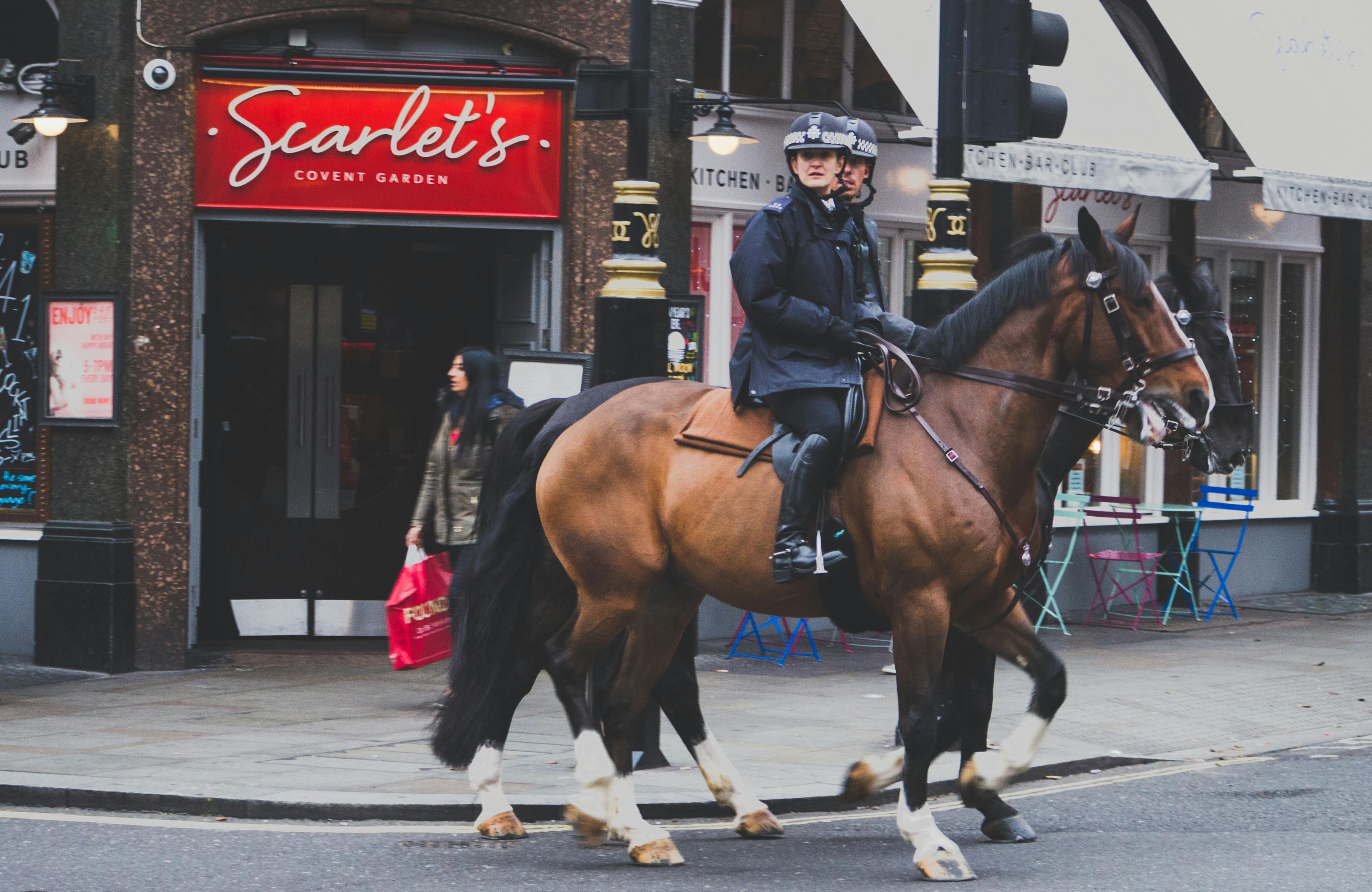
Image of two police on police horses riding by a cafe called 'Scarlet's Covent Garden'. Source: Dom J https://www.pexels.com/@dom-j-7304/
Earlier this year much media attention was given to army horses with no riders but here I want to focus on the less commented on presence of mounted police. This involves considering the value of recognising animals (and specifically horses) as workers who contribute to human communities (see here by a group led by Wadham, Monterrubio and Dashper which I am learning through being a part of, and – by Kendra Coulter (2019) – here).
Social control and social protection?
Crowd control during or in anticipation of violence – and arguably the dispersal of crowds seeking to protest peaceably – have been the core use of horses by the police. The concern that mounted police are agents of oppression has been claimed in response to police actions around the world.
For many of us police undertaking crowd control provided our first ‘meeting point’ with horses. I discovered horse riding in my mid-40s, but I came across “working” horses in cities at football matches as a child. I remember the police horse presence as a sign of anticipated violence from Leicester’s ‘Baby Squad’ when Liverpool F.C. visited Filbert Street in the 1980s. In those years, mounted police outside Anfield (care and/or control?) ‘greeted us’ after we had walked to a match over Stanley Park from my Nan and Grandad’s house. Later, as a young adult, I ‘met’ horses on political marches: in the 1990s, on an anti-racist march in London in the aftermath of the racist murder of Stephen Lawrence, I remember a wall crumbling after pressure from police horses pushed us like a river against a stone bank.
In the UK context, Foot and Livingstone (2022) – with a focus on the Police’s role in suppressing protest – provide many examples of the excessive use of mounted police, including at Orgreave in 1984 (when striking miners ran from police charge after charge on horseback, for hours). In many countries, horses continue to be used by police forces, sometimes resulting in injury to the public (examples here and here) – and, including in the current violence, harm to police animals themselves.
The far-right-instigated violence we have seen in British towns and cities in early August 2024 has been shared via rolling news footage. Many have experienced the violence and the fear of racist violence directly – or may know where disorder has taken place and be concerned for friends, family and community. (My Nan and Grandad referenced above lived off County Road in Liverpool, an area hit by far-right orchestrated damage). In some instances, mounted police have been deployed: whilst this has been in response to racist violence, it has also reminded me of that anti-racist march experience in my early twenties. Beyond social control and social protection, what other frames can we bring to police horse engagement on the streets? Could they be a non-human animal version of your ‘friendly neighbourhood bobby’? Whilst there has been a decline in neighbourhood policing in recent years and not everyone experiences street-based policing as a public good, there may be merit in considering the “horseperson” as a community police worker role. Giacomantonio et al (2015) highlighted that as well as ‘making barriers’ on the streets, police horses break barriers between members of the community and police officers. Could the presence of an animal connect human citizens to human officers, and maybe horses could themselves be seen as community workers?
One place where there is some ‘friendly’ visibility of the police horse is on social media: on X we can see different mounted divisions in the community (e.g. Gloucestershire @GlosHorsPol; West Yorkshire @WYPHorses).
Building bridges?
So horses can make barriers and break barriers. How about building bridges? The human world with horses (like many other spaces) needs to get its house in order (with racism to address within equestrian culture, for instance). However, the horse is a significant cultural symbol across much of the global human population and UK communities. Perhaps we need to be supported to contemplate the horse itself – beyond the work it does (such as for the police, the riding school or the equine-assisted therapist) – as part of recognising ‘there is more that unites us’ than divides us. In our different religious traditions, our historical stories, our myths and through our arts – the horse has produced who we are collectively today. Before they were asked to assist the police, they helped us travel long distances and share our cultures.
And yes, we also have put them to war. Horses can also ‘speak’ to us of human troubles – of militarism, of conservatism, of hierarchy, of exploitation.
Maybe the story and the being of the horse can help humans engage – with our own needs and with each other – in more profound, constructive and creative ways. Space both to engage in what is shared, and where there are exclusions and barriers to overcome.
See, for example, how Summerfield Stables (Birmingham), Urban Equestrian Academy (Leicester) and Ebony Horse Club (London) offer the benefits of horses to humans from or in urban settings.
Reflecting our interest in the more-than-human world, including but beyond horses, I also see smaller animals’ contribution to our communities (through talking to people both visiting and volunteering at Balsall Heath City Farm).
Yes, we need safe streets and safe communities. And just maybe, there is value in asserting the importance of human-animal relationships as part of that ongoing aim. Animals can be used as interventions to control us or explicitly to help provide us with well-being—this can mean they are controlled to deliver what we want from them. From a welfare and well-being perspective, considering where there are more opportunities we could produce for animals to be alongside us (each of us safe, well, and not facing harm or threat) has a lot of merit.
References
Coulter, K. (2019) ‘Horses’ labour and work-lives: new intellectual and ethical directions’, in J. Bornemark, P. Andersson and U. Ekström von Essen (Eds), Equine Cultures in Transition: Ethical Questions, London: Routledge.
Foot, M. and Livingstone, M. (2022) Charged: How the Police Try to Suppress Protest, London: Verso.
Giacomantonio, C., Bradford, B., Davies, M., and Martin, R., (2015) Making and Breaking Barriers: Assessing the Value of Mounted Police Horses in the UK, Cambridge: RAND. Available here.
Wadham, H., Monterrubio, C., and Dashper, K. with colleagues (2023) Interspecies perspectives on decent work: inequalities and new solidarities in work between people and equids (part of The Sociological Review Seminar Series 2023). In: Interspecies Perspectives on Decent Work – Seminars 1 and 2, 24th May 2023 – 21st June 2023, Online.
Note: A brief history of mounted police in the West Midlands can be found here
 Interspecies Insights